
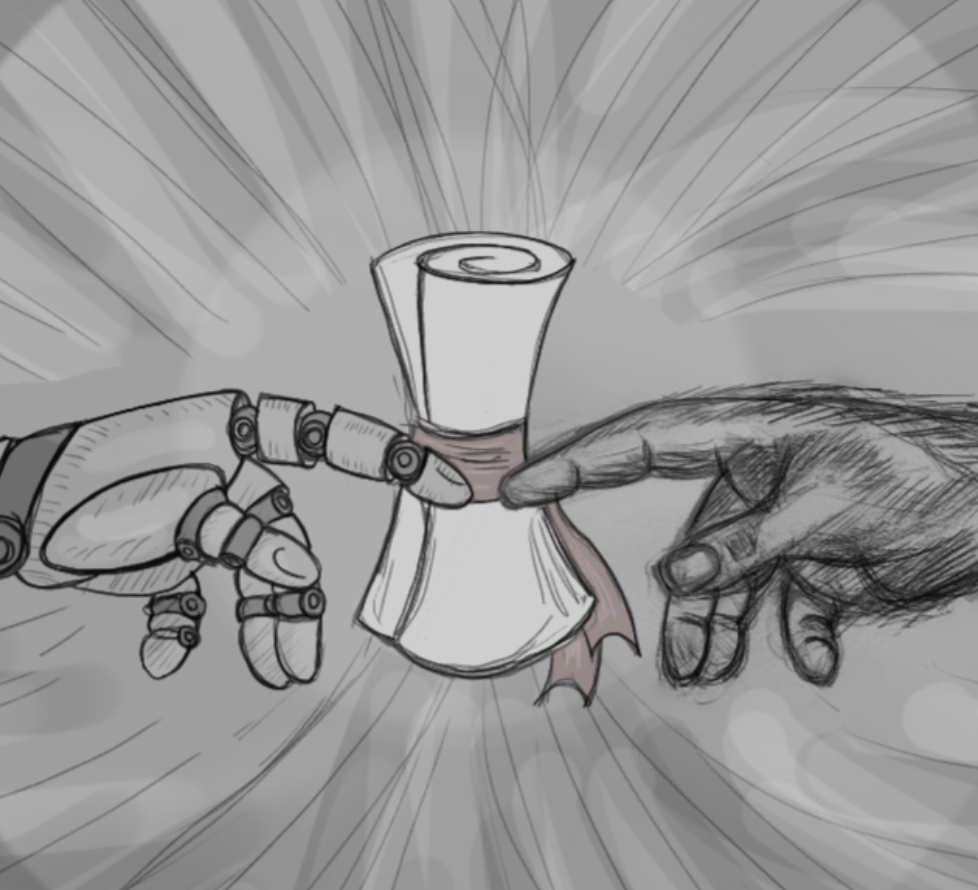
From the development of irrigation in ancient Mesopotamia to the establishment of high-powered data centers in Silicon Valley, humanity’s tendency toward innovation has led to the creation of technologies that have changed how societies live and interact.
The latest technology to shift the population’s way of life is artificial intelligence, and it has raised an array of questions and concerns.
Education is one of the many areas in which AI has inspired a multitude of reactions. It provides students with tools that can facilitate research, studying and completing assignments. However, it has also raised concerns about how students may be abusing AI by using it as a substitute for learning.
Christopher Machado is a professor of human physiology who has taught at Cuesta for 12 years. Throughout his time teaching, Machado has noticed a difference in how students complete their lab reports.
“I became very accustomed to the typical kinds of answers that students will generate for questions in those lab reports,” Machado said. “Over the last few years, since AI has increased in its accessibility, I’ve started to see some very untypical answers.”
Machado experienced a similar shift in education with the rise of technology during his graduate school years.
“We had the internet back then, and it was just starting to get much more accessible and robust in the amount of information that it had,” Machado said.
The internet changed education because it gave students access to more information and new tools for completing assignments and projects. From Canvas to digital textbooks, much of education today takes place online.
The introduction of AI into everyday life has raised questions about its new role in education.
The students who are currently experiencing the impact of AI on education have responded to it in different ways. In an anonymous online survey, Cuesta students were asked what they think of AI and how often they use it. Of 61 respondents, 41% said they never use AI for studying, and 11.5% said they always use it. Meanwhile, 32.8% said they sometimes use AI for studying and 14.8% said that they rarely use it.
Machado said that in graduate school, he was trained to see the internet as a tool for his work. He said that technology like AI and the internet can be compared to a library because they should both serve as sources for gathering information rather than replacements for knowledge.
“There will be situations in your professional life, whether you’re a scientist in a laboratory, working in some sort of clinical environment or whatever, when you may not have the time to go to your phone and look something up,” Machado said. “You should know certain critical information in your best computer, which is up here in the brain.”
Of the survey respondents, 47.5% said that they purposely avoid using AI for certain tasks, and 6.6% said that they never purposely avoid it.
Some of the respondents cited concerns about privacy and the environment when asked about reservations toward AI, but a more common concern was the consequences of AI in education. Many respondents cited critical thinking, creativity, and self-reliance as at risk.
Despite these concerns, some respondents approached the subject of AI with nuance. They acknowledged the downsides of using it, but also said it has potential to be useful.
Kessiah Bronson, a Spanish tutor, and law, public policy and society major at Cuesta, doesn’t think AI will ever be eliminated. She said that AI should therefore be embraced and molded into a tool that can benefit society responsibly and that it can aid learning rather than overtake it.
“I want to learn the material, and for me, to learn the material is to actually understand and use my critical thinking,” Bronson said. “With critical thinking, you are starting on the basis of what do you know? And how do you connect what you do know to this new material?”
“Creating these connections is important, especially for me, because law is so big and we have so many texts, we have so many words, so I need to rely on my brain to make those connections,” Bronson said.
Some students take greater advantage of AI tools to enhance their education, such as Rubi Molina, a first-year nutrition science major. For example, Molina uses Quizlet’s AI feature for uploading notes that can be used to generate flashcards for studying. Molina said that AI has helped her learn the material while experiencing a tight schedule.
“It has saved me a lot of time,” Molina said. “I’m taking 20 credits, and I’m working and I go to the gym. It gets very hectic, so it has been very helpful.”
However, concerns about AI have also led some students to develop an aversion to it. Such as Kenzi Cloward, a studio arts major at Cuesta College.
“I just don’t want it as a part of my education,” Cloward said. “I don’t like it. I understand that it’s something to keep note of, but I don’t think it should be in everyday people’s hands. I think it’s a tool for professionals in certain areas, and I definitely don’t think it should be in education.”
Of the survey participants, 41% said that they also felt concerned about how AI will impact their major or field of study. Meanwhile, 57.4% of students responded somewhere in the middle, with 6.6.% leaning towards excitement and 19.7% leaning towards concern. Only 1.6% said they felt excitement.
Some of the respondents who felt concern said they were worried about how AI could potentially replace the role they were intending to play in the workforce after getting their degrees.
“It has definitely changed my career projection,” Cloward said. “I want to be an artist who goes to galleries and stuff, but I probably would have chosen marketing and graphic design if it wasn’t for AI.”
Cloward said she initially wanted to pursue graphic design or marketing because it was considered an easier path for an artist. However, with the rise of AI in the graphic design and marketing industries, Cloward said she felt more inclined to take the risk of majoring in studio arts.
Some of the respondents who felt either excitement or neutral about how AI might impact their field elaborated by saying that their desired careers could be either enhanced or unaffected by AI. The reasons cited included AI’s inability to provide specific services and its ability to produce results more efficiently.
Molina said that she hasn’t looked into how AI could become an obstacle to her career goals. As a nutrition science major, she feels secure in her options.
“I feel like it is in demand, so I don’t think AI matters a lot with what I want to do,” said Molina. “I also want to be a doctor as well, so I feel like, if anything, AI would be helping me because AI does help a lot in medical fields.”
Bronson also said that she feels secure in her field of study because law often requires interpretation, and she thinks AI would not be able to interpret things like the Constitution or the Amendments in the same way that a human being can.
“A robot is a robot; I don’t think it will care humanely about how we interpret things,” Bronson said.
Some of the survey’s respondents said they felt concern over AI’s tendency to make mistakes. Due to limitations in its design, AI is capable of giving inaccurate, false or biased information.
“There are a lot of things it’s not capable of doing, and even if you have AI write something for you, if you don’t go back and check it you’re going to see a lot of problems,” said Katy Dittmer, a Cuesta psychology instructor and Division Chair of Movement and Health Sciences.
Despite the array of benefits and downfalls that AI presents, many people remain uncertain about its future in education and the job market.
“Some people are at the cutting edge of it and paying lots of attention maximizing the use of it, maybe overusing it, but I do think we all at some point need to get up to date on the ways that it can be advantageous because it really can streamline our work, free us up to do other things, but then there is the dark side,” Dittmer said.
Technology has gotten more complicated since the dawn of civilization, and it continues to raise questions about the future of society. Both students and faculty are exploring territory that may feel uncharted at times.
“It’s growing really fast; my husband works in tech and there’s a real fear for him in tech: How many positions are going to be replaced by AI?” Dittmer said. “For now, it’s not happening, but could it happen? It’s hard to say.”