

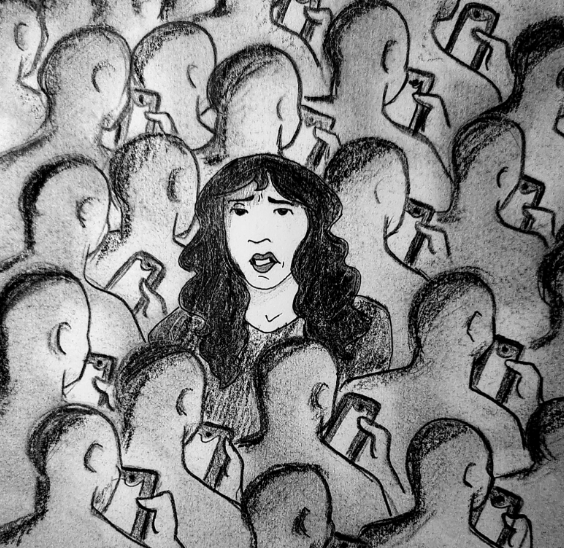
Vision strained and head tired, you look up from your phone screen to glance, bleary-eyed, at the clock on your nightstand. The neon blue glow reads “12:01 a.m.,” and slowly you move upright from where you’ve been awkwardly sprawled on your bed for the past hour and a half. Your fuzzy brain realizes you have barely moved since coming home from your late shift.
You only wanted to turn your brain off for a while, so why now does it feel more tired than before? Time has jumped by without you noticing, and what was supposed to be a quick break has now become a big waste of time. Reality may have left you for a little while. But the work you need to have done for your 9 a.m. class tomorrow– scratch that, today– is still there when it returns, unfinished.
Sighing, you force yourself to stand and pull the computer from your half-empty backpack in the corner. Settling at your desk, you briefly consider using your fingers to keep your eyelids open or finding another energy drink in the fridge. Eyes squinting from the bright light of yet another screen, you think, “Either way, it’s going to be a long night.”
In the current digital age, perhaps this could look like your life, your professor’s life, your classmates’ lives… really, everyone’s lives. As society continues to accelerate into a more technologically advanced world, it is no secret that new challenges have been presented to those who both learn and teach in the academic environment.
While students struggle to keep a balance between their phones, their relationships and their studies, professors must navigate the rise of new AI technologies and redefine course structures. These issues are without a doubt universal across many colleges and universities – but what shape do they take on Cuesta College’s own campus?
Ashley Hart, a licensed clinical psychologist and mental health therapist with Cuesta’s Student Health Services, explained the benefits she has observed when students and screens clash. “Technology – both in academics and relationships in our own self-experience – there are a lot of positives, of course,” she said. “We can be more connected, we have access to a lot of information… there’s a lot of inspiration and motivation that comes from reading and watching other people doing things we’re interested in.”
However, she admitted that excess time spent online presents just as many – if not more – consequences. “The students that I work with as a psychologist, specifically in therapy and in groups, will often talk about how hard it is to meet other people and meet that initial connection,” she said. “When you go out on the campus, or you’re at a restaurant – or you could be anywhere – what do people have in their hand and what are they looking at? We all have our phones… many of us are looking down, meaning we’re not looking up and seeing the people walking by us, and there’s a lot of missed opportunities for connection.”
Hart uses the term “technoference” to describe how screens can become a distraction for students. “It’s kind of one of those vocabulary words that is newer to us on this topic,” she said. “Technoference is really anything that creates an interruption in your experience that’s specific to technology.”
Cuesta students themselves have also noticed the impact of technoference in their own lives.
“Literally every day I tell myself, ‘Oh yeah, I’m going to use my phone less,’ and that never happens,” third-year sociology major Wafa Bhatti said. Describing how she often spends over half of her time on screens “goofing off,” Bhatti wishes there were more accessible ways to avoid “doomscrolling” and being distracted by her phone. “By the end of the day, I’ll see, you know, four hours spent on Instagram, and I’m just disappointed in myself,” she said. “But I can’t stop.”
Psychology student Karina Torres agrees, explaining how easy it is to get stuck in a scrolling cycle, especially when she starts to feel worn down from doing her coursework. “It’s mostly when I’m starting to get burnt out from studying,” she said. “Usually I’m pretty focused, but once I start getting tired, I tend to possibly get distracted.”
Hart attributes this to the way the reward system in the brain operates to crave instant gratification. “These types of things that we’re watching on the screen – so, I’m thinking about YouTube, video games, social media – these are high-dopamine activities, and so they are lighting up the reward system of the brain,” she said. “The challenge with that – and some of us are more susceptible than others – is there’s the potential for addiction. We do it so much that it starts negatively impacting our functioning…taking time away from our studies, taking time away from relating to people around us, and then we have a hard time monitoring or controlling that because that reward system is lit up by those dopamine receptors.”
Torres also commented on the large online component of her classes, with many of them using completely digital textbooks. “I kind of just want to have more physical books – which is kind of a little bit more old school nowadays– just to give my eyes a break from screens, I think – just to have a little bit more balance there,” she said.
“I think because I’m on a screen so much, it’s made my eyesight worse. I feel like I constantly have to wear my glasses more. Which is fine, but sometimes I think that maybe if I didn’t have as much screen time, I wonder if I would even need glasses,” she said. Torres explained that her psychology class in particular requires a lot of online reading, which, along with creating vision problems, sometimes causes her to feel fatigue.
However, the rise of technology and screen addiction isn’t just a student-centered dilemma. Professors also suffer, many having been forced to shift the structure of their courses to fit a more digital narrative.
Historian Zach McKiernan affirms that the growing popularity of AI platforms has been one of his biggest challenges while teaching history classes at Cuesta. “I found, much to my dismay, that students would use AI to complete homework questions. For me to have to read things that were generated by AI, contact the student, make an appointment with the student and discuss the policy of the course, which was no AI… it could take 20 hours,” he said. “It’s a mountain of time. And it’s very frustrating on a lot of levels.”
McKiernan explained how he values “process over product,” and finds it very important for students to engage directly with the material, with him, and with one another.
“That’s neat… students wrestling with things and thoughts and analysis. On the contrary, if you just take a prompt and you plug it into ChatGPT, you get content, but you didn’t think of it,” he said. “There was no process involved… you don’t have ownership of that. You might get the ‘right answer’ or close to the ‘right answer,’ but that’s not what I’m concerned with. I want process.”
Due to difficulties with students’ academic honesty and violation of the course policy, McKiernan said that he now tries to teach his classes as independently from Canvas and other digital platforms as possible.
However, he does enjoy utilizing slideshows and video or audio presentations for his students. “It’s not like I’m just sticks and stones, you know? I do lean on technology to that degree or to where I think it is enhancing the students’ understanding of the material,” he said.
As a historian, McKiernan also analyzes the timeline of evolution where digital media is concerned, using the analogy of a college student who has just moved out of their parents’ house. “There’s this liberation, and you’re drinking and having fun. But then you go through your 20s, and at the end of the night or the end of the decade, you sort of feel like you went too far. You did too much and you’re hungover,” he said.
“I think that’s sort of how I envision all this… everything is just so quick. The internet here, and the AI there, and it’s so fast and everybody’s so quick to jump on the bandwagon,” he said. “And now I feel like maybe some of us are stepping back, like things are maybe moving a little too fast.”
McKiernan encourages students to be intentional about the time they spend on screens and to prioritize time for creativity and critical thinking without digital influence.
He describes how, in today’s society, it can be more challenging than ever to step away from technology and study without distraction. “I’ve changed, and I’ve been challenged because of this digital age that we’re in,” he said. “And as I tell students, when things are challenging, that’s good because that means you’re getting better. If things were easy, then what was the point?”
For students who struggle or feel frustrated with the amount of time they spend online, Hart also advises them to ask themselves questions such as, “Am I happy with the amount of time I’m spending on the screen? How is it impacting me? Do I want to make changes?” She went on to say: “From there, you can come up with really concrete solutions to create some boundaries around your screen use,” she said. “It doesn’t have to be perfect, but with that awareness, slowly but surely you can start to change those behaviors and make them more your own, versus being driven by the screen.”
After years of talking with students at Cuesta, Hart believes screen addiction presents a true problem – not just on campus, but in society as a whole. However, she views the digital struggle with optimism, encouraging everyone – but especially students – to practice self-awareness and discipline when it comes to time online. “It’s kind of the minority experience at this point if someone is not constantly on their device, right?” she said. “So we really have to be conscientious and intentional about our screen use.”