

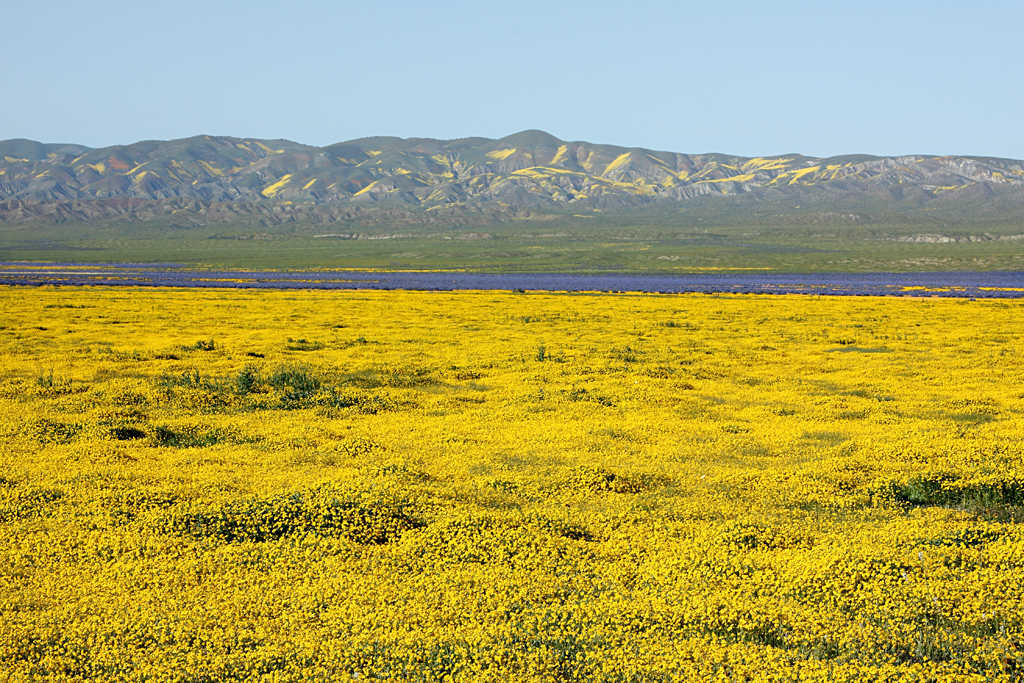
If you drive out to the Carrizo Plain today, the landscape looks almost untouched. Green grasses and wildflowers stretch across hillsides that burned less than a year ago, framed by the surrounding mountains. It is hard to imagine this was the center of California’s largest wildfire just months ago.
On July 2, 2025, a wildfire broke out along Highway 166 near the edge of Los Padres National Forest in San Luis Obispo County. The fire ignited in an area dominated by dry, non-native grasses along the roadside, the kind of flashy fuel that catches quickly and spreads fast. Fueled by summer winds, the Madre Fire spread rapidly across the Carrizo Plain, scorching nearly 81,000 acres over 24 days. By the time it was fully contained July 26, it had burned through portions of Los Padres National Forest, the Carrizo Plains Ecological Reserve and Carrizo Plain National Monument, landscapes that in some cases had not seen fire in nearly a century. Fires of that size often leave behind severe erosion, damaged ecosystems and years of slow recovery. But what is happening now raises a question many people do not think to ask after a wildfire: in some California landscapes, was fire always meant to be part of the system?
“The recovery happened faster than many expected,” said Johna Hurl, manager of the Carrizo Plain National Monument.
After a fire of this size, exposed soil on steep hillsides becomes vulnerable to erosion, especially before new vegetation can take hold. Without plant roots anchoring the ground, heavy rainfall can trigger runoff, landslides and sediment flowing into nearby waterways, threatening water quality and wildlife habitat downstream. With so much ground burned across the Carrizo Plain, land managers worried that winter rains could wash sediment down hillsides and across the valley floor before plants had time to recover. But the rains arrived earlier than usual, and the landscape responded quickly.
“The grasses and flowers grew and helped stabilize the soil on the hillside and the valley floor,” Hurl said.
For much of the past century, fire was absent from the Carrizo Plain. Without it, vegetation became overcrowded, fuels accumulated and some native species slowly lost ground. Cal Fire San Luis Obispo Unit Forester Dave Erickson said native perennial bunchgrasses, including species such as purple needlegrass and blue wild rye, have deeper root systems that help stabilize soil, retain moisture and store carbon. Unlike invasive annual grasses, they tend to stay green longer into the dry season. Invasive annual grasses, which have spread widely across the Carrizo Plain and much of California, dry out quickly and create fine fuels that ignite and spread fire more easily.
“There were some areas that hadn’t burned in almost 100 years. They were overdue to burn,” said Eva Grady, a Cal Fire captain and public information officer.
Yet many of the plants here are built for exactly this. Some chaparral shrubs resprout directly from their root systems after burning, while other species rely on dormant seed banks in the soil that only activate after exposure to smoke or heat. In the Garcia Wilderness, some cone pines cannot reproduce without fire at all – the heat is what releases their seeds.
“Those trees don’t reproduce without fire,” Grady said.
If fire is something these landscapes need, some agencies and tribes are beginning to intentionally put it back on the land through prescribed and cultural burns. Prescribed burns are carefully planned fires set intentionally to reduce fuel loads, restore native ecosystems and lower the risk of larger, more destructive wildfires in the future. Erickson said Cal Fire is currently conducting vegetation management projects near Camp Roberts as part of a broader effort to reintroduce fire to landscapes that have gone too long without it. The goal, he said, is not just to reduce hazardous fuels but to restore the ecological balance that fire has historically maintained in California’s grasslands and shrublands. Earlier this year, San Luis Obispo County held its first Northern Chumash cultural burn since 1850, led by the yak titʸu titʸu yak tiłhini Northern Chumash Tribe in collaboration with CAL FIRE and local agencies, a sign that the relationship between people and fire in this region is being reimagined.
“Fire is very beneficial – where it is not beneficial is the impact that it has on people’s homes,” Grady said. That perspective shaped how crews approached the Madre Fire itself. A Cal Fire vegetation management burn completed in spring 2025 slowed the fire when flames reached the treated area. “It burned right into our spring burn and slowed the head of the fire,” Grady said. “It gave us the ability to contain it at a much smaller footprint.”
Today, the Carrizo Plain looks alive again. But what happens next is still unfolding. Researchers, fire officials and land managers will continue studying how native plants, wildlife and grasslands recover in the years ahead. The Madre Fire was destructive – but it also reopened conversations about how California landscapes evolved alongside fire, and whether learning to work with it, rather than simply suppressing it, may be one of the most important challenges facing the state.