
The Cuesta College experience can take on many forms, but one thing that most agree on is that Cuesta feels safe. Feeling safe is fundamental to education, as many intuitively know and understand that worrying about safety is not helpful to learning. Cuesta College has many advantages in this field: it is located in a low-crime area of an already low-crime county. Additionally, the campus has a well-staffed security department and many additional support structures for students.
Yet the feeling of campus safety only goes so far. Surprise power outages, large-scale smoke pollution from controlled burns, and even occasional artillery exercises snap us out of the doldrums of comfort and confront us with our ignorance about what we, in an actual emergency, are supposed to do.
When you talk to Public Safety Director Jesse Herring about this, he will quite fairly point to the My Cuesta Alert app and the email and message alert systems in place. Additionally, we have a public address system and are rolling out a CCTV system to enhance security across campus. Lastly, almost all rooms are fitted with the Campus Emergency Light System, which, together with the My Alert app, should provide campus-wide information on what to do in an emergency.
However, are we all aware of this? I suppose the answers are out there, yet awareness and training are two different things.
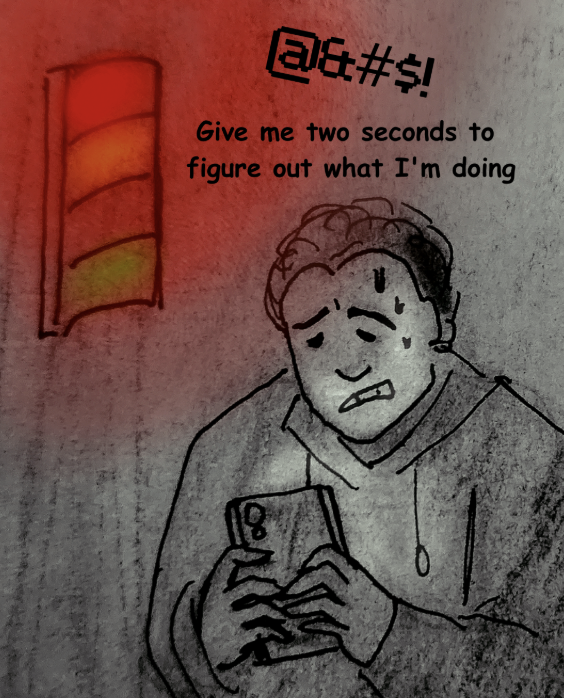
Let us assume the light turns on the Campus Emergency Light System turns amber. My first reaction would be to get up and walk over to the light to read what I should do. I do not know it automatically. I would need to learn on the fly. The amber light is supposed to indicate stand by and wait for the My Alert app message. I have asked 43 students on campus at random if they have the My Alert App, and only 7 answered in the affirmative. Additionally, the Google Play Store page suggests that fewer than 100 people have downloaded the app. I guess now, as the light is already orange, would be a good time to download and sign in to the app.Taking a moment to understand how truly unfamiliar the student population is, before factoring in the additional challenges that dyslexic and red-green colorblind people would face in a stressful moment like this. As some of these systems are a bit dim, trying to figure out which light specifically is on can be trickier for the visually impaired or near-sighted people.
The problem then isn’t that we do not have systems – it is that we are not familiar with them. The college believes that this is a case of balance between students and administrators. They have low communication in this regard because they feel, on some level, that we want to stay infantilized and are fundamentally uninterested in learning more about the safety around us.
I say, if we truly are uninterested, then beat us over the head with it.
Every time you board a plane, you go through safety procedures. Chances are very good that on most domestic flights, there is not a single passenger on their first-ever flight. Chances are still good that this might be the same aircraft model. Nobody is inherently interested, partly because it is uncomfortable to think about the scenarios outlined, and partly because we do not really assume a disaster will happen. Otherwise, nobody would board a plane. Yet this is ignored, and we all view the safety briefing every time we taxi to the runway.
This is the stance I would like Cuesta to adopt. If you enroll in even a single course in the semester, a safety video or PowerPoint should be emailed to you. The first day of class is already very front-loaded with going over the syllabus and learning the course’s academic metrics. Why not spend five more minutes discussing the gathering spot for the particular classroom in case of a fire? On top of this, a comprehensive PDF could be linked anywhere on the Cuesta home page or in Canvas, be easily accessible throughout the semester, and be downloaded to any computer for quick review. These measures are easy to implement, cost very little in terms of production quality, and would no doubt be of immense use to all students in the event of an incident.
The administration says that safety is a two-way street between us and the administration, and that we are just not willing to engage. I would say that visiting higher education institutions should come with the understanding that we can expect safety on campus and be taught about safety, thereby providing a better learning experience for all students.