
Students often feel left out of the loop on Cuesta College’s campus.
From missed opportunities to attend political events to an overall lack of knowledge about campus resources, students at Cuesta often feel like they don’t know what is happening at their own school.
For some students, this works well. They come to campus to attend class, get the grade and go home, counting down the days until they graduate and are off to their next endeavor. However, for students who want to connect more and build roots in the place they will be calling home for a couple of years, this lack of connection to campus can feel disheartening.
College is known to be a place that fosters freedom of thought, independence and self-expression for students as they come into themselves and prepare for careers in the world, yet students on Cuesta’s campus say that they feel infantilized.
They feel that the school’s lack of communication and low interest in creating channels for student input to be truly heard keeps them stuck in a state of disempowerment on campus.
This feeling was confirmed for students by the email outage that occurred Feb. 20 through Feb. 23. It was not the outage itself, but the fact that students did not know it had occurred. Aside from a single story posted to the Cuesta Instagram account, there was no attempt to alert students of the outage.
It is one thing to feel left out of communication about certain campus events, but what if there were an emergency? The outage made students ponder their sense of safety on campus and ask themselves if they trust Cuesta to communicate effectively in critical situations.
The answer was found in memories.
The student death that occurred on Jan. 21, 2025 was a major incident that called into question their safety on campus.
Students received one email from Cuesta College President Jill Stearns on the day of the incident notifying them of the fact that a deceased body had been found on campus. There was no mention of the cause of death, or any additional information provided by the school in the following year. It wasn’t until Feb. 16, 2026 – 11 months later – when The Cuestonian received the coroner and investigative report from the SLO County Sheriff’s Office after filing a California Public Records Act Request, that students and faculty found out that the death occurred from natural causes.
Students recalled feeling confused during this time, and that the lack of communication and support left them to make their own guesses and to hope that, since the school offered no additional information, they weren’t in imminent danger.
The frequent power outages of 2025 were another cause for concern among students. These outages resulted in classes being cancelled, which, for some students, meant a long commute and the use of gas just to turn back home. Several students reported hearing about the situation from their professors or a paper note taped to their classroom door, rather than from the college.
Over 50% of California community college students work while also attending school, meaning that driving to school unaware that classes are cancelled takes precious time away from other opportunities and commitments.
The controlled burns that occurred in fall 2025, when large clouds of smoke overtook the SLO campus, were another time students called into question both safety and communication on campus. Students were unaware of the cause of the excessive smoke, causing stress across campus, especially for anyone with a health condition exacerbated by smoke, who were left without the choice to not come to school that day.
Although Stearns verified that the school did not receive advanced warning of the fires from Cal Fire, this moment stands out in students’ minds as a time when they not only wished for more communication but also questioned their understanding of how emergency drills work on campus.
Students acknowledged that if there were to be a fire, lockdown, shooter or some other major emergency, they would have no idea what to do, relying solely on the hope that their professor is up to date on their emergency training, which is optional for faculty to attend.
Cuesta Chief of Police Jesse Herring said the reason for a lack of student participation in campus emergency drills is that state requirements differ significantly at the college level compared to elementary and high school. The only regular student-included drill at Cuesta is the Great ShakeOut, an international earthquake drill that takes place annually in October; this year’s will be on Oct. 15.
Although students often feel kept in the dark on Cuesta’s campus, this does not mean the issue is black-and-white.
Cuesta has made attempts to improve communication with students. One of these ways, particularly regarding campus safety, is the Cuesta Alert app, which was released in Nov. 2025.
The app offers emergency updates and a channel for direct communication with Cuesta Police to request escorts, get help, or simply to answer questions.
Although the app is a great move for improving campus safety, and works well for those who use it, there are problems. First, the large number of students who still do not know of its existence, and second, that it requires students to monitor yet another platform for Cuesta notifications besides their student email, Canvas, Pronto and the Cuesta Instagram account.
The addition of yet another platform points to the lack of student representation in these conversations. If Cuesta had taken a poll or held a town hall meeting to gather input, students would have said that adding another app feels exhausting amid their already busy schedules and could have offered alternatives.
Herring acknowledged that students might be turned away by the hassle of downloading another app, but promised that notifications from the app are significantly faster than any information received by email. Herring also pointed to the installation of the new campus-wide camera system and improvements to emergency call boxes around campus, saying this will greatly improve safety communication on campus, especially for students using the Cuesta Alert app.
It might seem silly for students to question safety at Cuesta when the campus is known for its low crime rate, but this could be said for a lot of schools that have been faced with emergency situations, tragedies and gun violence.
Cuesta students want to feel safe not only in their physical environment but also in knowing that their voices are heard and that they matter. They want fewer barriers to accessing information on campus and to be treated as adults who are capable of handling critical information.
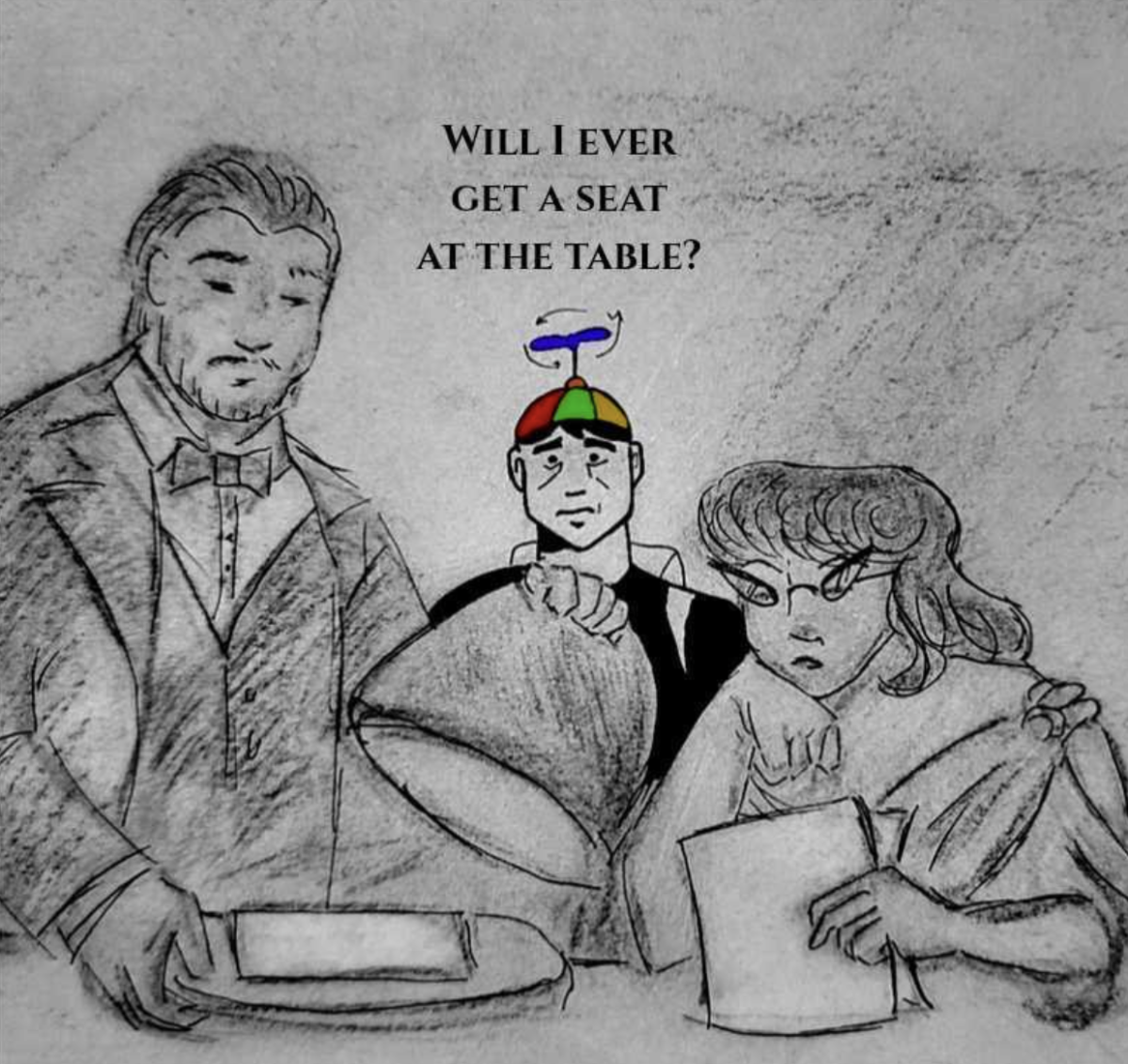
It is true that it is not solely on Cuesta to fix its communication with students; student advocacy is essential for change. However, if students feel perpetually stuck at the kiddie table on campus, how will they learn to speak up for themselves and become more engaged and active community members?
Cuesta has the potential to be an incredibly empowering campus, leaving the majority of students who attend feeling capable and energized for their next chapter, but without true inclusion of its students, the reality that exists on campus is far from this.
Editor’s Note: The Cuestonian Editorial Board consists of the staff. Those in an editor position typically write the editorial.
Editorial topics are pitched by all members of the staff and a single topic is selected for each editorial. Each staff member votes on their position on the selected topic and the majority position becomes that of the editorial. In the event of a tie on the first vote, staff members engage in continued discussion and state the reasons for their initial vote. A second vote is then taken and the majority position becomes that of the editorial. In the event of a second tied vote, the editorial position will be decided at the discretion of the editor in chief.
For this editorial, The Cuestonian staff answered this question during class: “Do you trust Cuesta to communicate effectively in critical situations?” All 12 of the staff members present voted no. Two staff members were absent. The Cuestonian publishes voting results to promote transparency.