
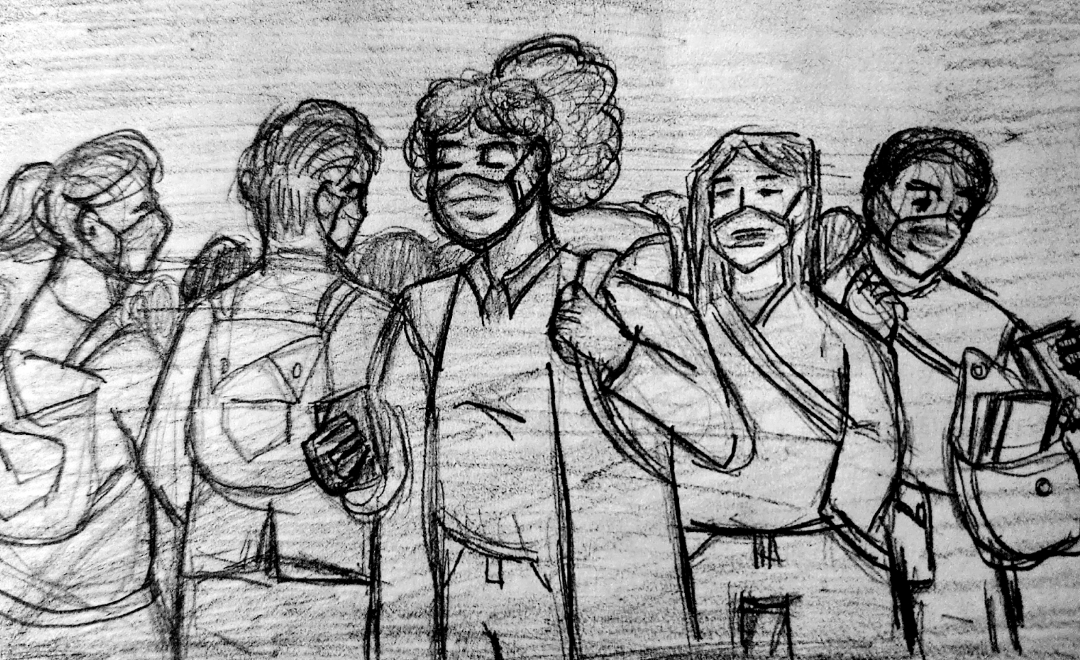
To remember the quiet classrooms and strangers hidden behind masks is to remember the overwhelming solitude among students during the pandemic. So the question is: do Cuesta students still feel the lingering effects of isolation since the COVID-19 era?
Throughout their educational journey, students discover how they prefer to learn. Whether it’s online or face-to-face, the environment students learn in can also influence their social experiences on campus. In a Cuesta student-focused survey, about 40% of respondents said they rarely feel lonely during the academic week.
From the same survey of Cuesta students, 49 out of 66 respondents said they feel their personality affects how comfortable they are in face-to-face learning and social spaces. In other words, the responses indicate that individual personality differences may influence how comfortable students feel engaging with others in academic and social environments on campus.
As a college institution, Cuesta aims to support students’ comfort and learning on campus. With the student health center, individual tutoring, and counseling, Cuesta offers a lot of direct student resources. Newly hired psychology professor, Sierra Feasel, leans into the importance of faculty supporting mental health.
“I think as professors we have a lot of direct contact with students, so I also see it as our role as faculty to really have those conversations with students and make it known that those resources are available and potentially reaching out to students that we notice are struggling or might benefit from those resources.”
She also spoke about her experience from teaching at University of Santa Barbara to teaching at Cuesta, and was asked what she noticed about students and how they changed academically and emotionally over the past few years since the pandemic, she said, “One of the things that sticks out the most to me is a change in just the connection that students feel in the classroom with each other, with their professors, and really their sense of belonging as a part of their school community,” she said.
Feasel emphasized that students’ sense of belonging was taken away from them too quickly. “Even five years since then, I think we’re still dealing with some of the aftermath of that,” she said. “It has been hard for students to kind of reintegrate into a face-to-face.”
Before and during the pandemic, Feasel acknowledged that there weren’t as many accessible resources as there are now, so students had to jump into a kind of “survival mode”.
Feasel dove more into what “survival mode” looks like by explaining that stresses can build up over time, “In terms of both our physical health and mental health, there really are things that we might consider in the moment smaller stress, but they really tend to accumulate over time, and that accumulated stress can have a really harmful effect on our cognitive functioning, our physical function, and our mental health,” she said.
Feasel highlighted social integration, the dynamic process of incorporating individuals, minority groups, or newcomers into the mainstream social structure, and connects that with psychological research suggesting that emotional well-being and academic performance influence each other.
Feasel said when students feel mentally healthy, they are better able to engage with coursework, but academic struggles can also negatively affect their well-being, which is why supportive learning environments are important.
Survey participants helped explain Feasel’s comments by showing that 25% of students say they feel slightly disconnected from campus and 36% say they only sometimes interact with classmates outside of school.
During the pandemic, students missed the usual on-campus social interactions, and the aftermath continues to affect them. These responses suggest that the pandemic’s social effects persist.
However, the Movement and Health Science Division Chair and Psychology Instructor Katy Dittmer offered a different perspective.
Transitioning back into face-to-face classes after the height of the pandemic, Dittmer noticed improved classroom interactions, including discussions, questions, and hearing other students’ perspectives.
She highlighted that students may take away valuable things from online learning, but said, “learning is also social. Online, the quality of education you get is diminished a bit.”
However, students do not all experience face-to-face classrooms the same way. While in-person learning may create more opportunities for interaction, more than half of survey respondents said they still feel lonely at least sometimes during the academic week.
When asked which personality trait best describes them, almost 50% said they were somewhat outgoing. That contrast helped explain why some students gravitate toward face-to-face interaction, yet acknowledge the potential for online learning to stifle social interaction.
Dittmer said that even though she’s taught online classes for 20 years, and that it’s more convenient for students, you miss the small social interactions. “You’re thinking more deeply about that material and that process. That’s how memories form. It is when we take that moment to think deeply, or somebody says something, and you think, wow, now I’m thinking about this totally differently,” she said. “All of that is so integral to memory into learning, and it’s hard to simulate that online.”
Dittmer’s observations also align with responses from Cuesta students. In the survey, nearly 70% of respondents said they learned most effectively in face-to-face classes, reinforcing Dittmer’s point that face-to-face interaction encourages deeper thinking.
Face-to-face classrooms also appear to play an important role in helping students feel connected to campus. For many students, the classroom remains one of the primary places where social interaction and academic engagement overlap.
While many students report improvement since the height of the pandemic, feelings of loneliness have not disappeared entirely. Although about 40% of respondents said they rarely feel lonely during the academic week, more than half said they still experience loneliness at least occasionally. These responses suggest that while students are returning to campus physically, rebuilding social connections can take more time.
Cuesta students’ experiences show similar trends to those seen in national research. A Michigan State University study tracking 248 young adults between 2020 and 2025 found that face-to-face contact gradually increased after the pandemic, while many participants also reported remembering online learning more positively over time.
Researchers also found that overall well-being improved, with participants reporting higher life satisfaction, less loneliness and more opportunities to see friends face-to-face again.
The study also noted that personality traits often matched individuals’ preferences for educational and professional environments, suggesting that comfort with social interaction may influence how students experience learning spaces.
For students at Cuesta, the survey responses reflect a similar pattern. While many value the return to face-to-face classrooms, personality and comfort with social interaction still shape how students participate in academic and campus life.
Many students are rediscovering the value of learning again. While loneliness and social hesitation have not completely disappeared, the return to discussion, collaboration and face-to-face connection appears to be helping students rebuild both their academic confidence and their sense of belonging.
Playlist by Tia Edwards
Editor’s Note: Katy Dittmer’s title was originally incorrect in the first version of this story. The issue has been corrected. The Cuestonian regrets the error.