
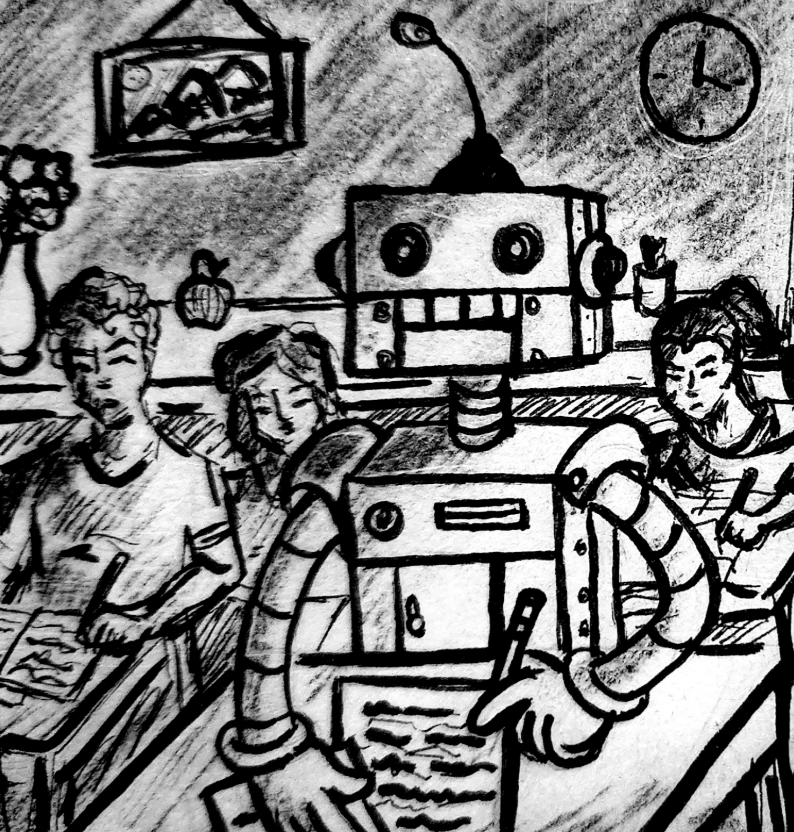
A 2024 report by the plagiarism checking website Turnitin said that of the 200 million student essays reviewed since the launch of Turnitin’s AI detection feature in April 2023, about 11% of papers had at least 20% AI content and about 3% had 80% AI content. The presence of artificial intelligence in academic settings has caused concern among students and faculty alike.
Elijah Berry, an agricultural business major at Cuesta College, said he began to feel anxious about being accused of using AI after reviewing his English professor’s AI policy, which he said completely restricted its use. His anxiety caused Berry to wonder if the use of tools such as autocorrect or the copying and pasting of his own original work would be detected as AI.
Berry also said that his friends shared similar anxieties about being accused of turning in AI-generated work. He said that a common fear they shared was being dropped from a course for accusations of using AI. Berry said that before AI became widespread, he did not have these types of fears. He said that he remembered taking AP English classes in high school and not experiencing anxiety over being accused of AI.
“I used to feel really confident that the ideas I was having were my own and I can write an essay,” Berry said. However, Berry said his confidence changed when he began to worry that his ideas might be traced back to AI. The fear of being accused of using AI has left Berry frustrated.
“I don’t like having the feeling of my own intellect being undermined,” Berry said. “I can come up with things because I’m smart too.”
Another Cuesta student, Téah Ross, said she was accused of AI-generated work last year, when she was still in high school. She said that a paper for her English class was labeled as AI by her teachers due to Ross’s advanced vocabulary in her writing. Ross said that the experience had created distrust between her and her teachers and that she felt disrespected by the accusations.
“I felt like I couldn’t turn in my best work because it would be counted against me,” Ross said. “Or if I used my best work, it would be counted as something that was not noteworthy because it was seen as fake or AI-generated.”
As Ross continues her education at Cuesta College, she avoids AI when completing her assignments because of her general dislike of it. However, she still has some worries about how her work is perceived.
“I try to make sure all my work seems genuine, even though I already do think that, it’s just that it’s in the back of my mind now,” Ross said. “Do people believe me, that this is me and my own effort?”
Sally Demarest, one of Cuesta’s English professors, said that the faculty has also been concerned about the impact of AI, and that she has been using several approaches when dealing with AI in her classroom.
On April 11, 2025, Cuesta’s Academic Senate Council approved a policy that requires Cuesta professors to outline their policy on AI use in their course syllabi. There are three different approaches to AI that professors can pursue. These ways include a restricted, conditional and open policy. Each of these policies allows different levels of AI use for assignments.
Demarest said that her colleagues have different ways of approaching situations in which a student may have used AI, and there have been many conversations about how to deal with them.
“A lot of us respond to it in different ways; some of us will be more likely to more quickly report to the office of student services when students are violating academic integrity, and some might be slower,” Demarest said. Demarest has not made any formal reports, but she has definitely experienced instances where students submit AI-generated work.
Demarest said that the most that can be done in situations where students submit AI-generated work is a failing grade on the assignment itself. She said that some colleges and universities may drop or fail a student from a course, but Cuesta professors can only fail students on assignments.
If a student receives a failing grade on an assignment they are dissatisfied with and is unable to reach an agreement with the instructor, they may make a formal appeal for a grade change.
“If I were to fail a student on an assignment because I thought that it was not their own work, they could appeal that,” Demarest said.
When trying to identify AI-generated work, Demarest said that she did not want to use websites like Turnitin due to ethical concerns. However, due to the rampant use of AI, she began to use it for her online classes during the spring and fall semesters of 2025.
“It was just getting so bad with the AI use, and the cheating and students submitting work that wasn’t their own, that I decided to use it,” Demarest said. “If students knew they needed to submit their work to Turnitin, maybe they wouldn’t make the same choices.”
Demarest is also careful when confronting students about AI use because she doesn’t want to accuse anyone unfairly. She said that one of the biggest factors in identifying AI work is checking whether the sources cited are real. If a source or citation is missing, instead of accusing students of using AI, Demarest said she addresses the problem of their nonexistent sources or citations.
“When I would get suspicious as I was reading a paper, then the first thing I would do would be to see: are these sources real? And a lot of times, they weren’t,” said Demarest. “If they were, the page numbers that they had in the works cited was not the actual page numbers of the article or the quotation that they had, I would go to those pages, and it’s not actually there.”
If Turnitin detects a significant amount of AI use in an assignment, Demarest gives them the opportunity to resubmit their assignment or complete alternatives that would demonstrate the student’s understanding of the material. Otherwise, Demarest will not assign a grade to the assignment, as stated in her syllabus.
One of Demarest’s main methods of mitigating the amount of AI work has been transitioning from teaching online classes to completely in-person instruction. Demarest said that AI use was most prominent in her online classes, but that teaching in person has allowed her to explore more analog options, such as blue books.
She said that students still type in class, and she still has instances where students turn in work with nonexistent sources, but it is no longer as common. Demarest said that when she was teaching online, the first thing that she would try to figure out when reading student assignments was if the work they submitted was their own. She said this caused an interruption to the type of relationship she wanted to have with her students.
“It’s so fantastic to just be in a class, be talking about something, and then just have my students write about it for 15 minutes in class and give their work, where I don’t even have to for one minute think, ‘did they write this?’ They don’t have to think for a minute, ‘is she going to think I didn’t write this?’” Demarest said. “It kind of gets back to just a sharing of ideas.”
Demarest said she acknowledges the value of AI, but she thinks being completely in person this semester has been more enjoyable because many of the worries that have surrounded AI are no longer present. She also said that other faculty members who teach subjects similar to English have been resorting to analog options because AI has been affecting classrooms.
“Because that’s the thing that we’re all trying to do, and that’s the thing that’s so frustrating, the way that it changes our potential relationships with our students and our students’ work,” Demarest said.