
There are many paths a student may take after high school. Some choose to immediately join the workforce, some choose to go to a four-year university, and many choose a variety of alternate paths. However, what is the best choice for a high school graduate who doesn’t know what they want to do?
Community colleges like Cuesta can be a valuable resource for those who are struggling with uncertainty after high school because not only is it an affordable option, but it is also a place where students can truly explore what they want for themselves while their brains are still developing.
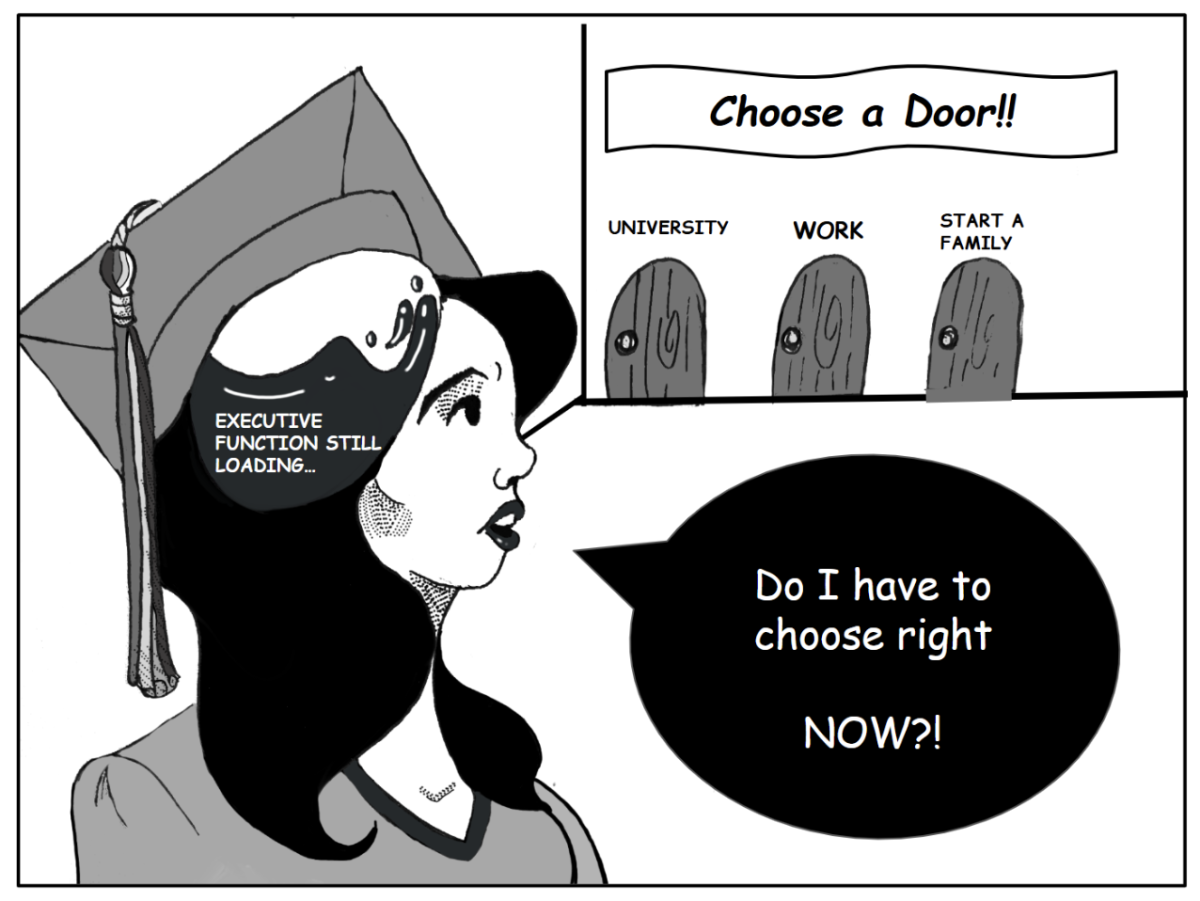
A 2010 research article from Harvard Medical School by Scott Edwards details how Frances Jensen, professor and chairman of neurology at Perelman School of Medicine at the University of Pennsylvania, describes the development of the brain. Jensen said that the brain develops from the back to the front; the regions in the back of the brain are responsible for motor functions, and the frontal lobe is responsible for a person’s executive function. Executive function is what allows people to make plans and decisions, and the frontal lobe may not fully develop until age 30.
An 18-year-old’s brain is not fully developed, and this is not necessarily a bad thing. A report by the American Psychological Association said that an adolescent brain is very flexible and is therefore capable of absorbing and responding to a great amount of information.
However, someone whose executive region of the brain is not quite developed may not be completely able to decide on what they want to do with their lives. Perhaps, instead of making teenagers choose what they want to do as soon as they graduate high school, it may be more beneficial for students to take advantage of their brain’s current capabilities to gain more knowledge and experience of the world outside of high school.
Kai Van Zerr, a biology major at Cuesta College, recently graduated from high school in 2025. He said that his experience in high school was a restrictive one, where bathroom breaks were closely monitored and lockers were often searched for contraband.
Van Zerr said that Cuesta has given him the freedom that he didn’t have in high school, and that it has helped reduce his anxiety. At Cuesta, Van Zerr has been able to explore his interests without feeling the pressure of being pushed towards a specific path. He was originally planning on pursuing a career in graphic design, but he later realized that he wanted to study biology.
“I can actually pick what I want to do,” said Van Zerr. “I’m not limited in my options, I don’t have to be an artist, I don’t have to be a software engineer, I don’t have to be either of those things.”
Community college proved to be a more freeing and flexible environment for Van Zerr that helped him explore his interests. However, it is also important to acknowledge that community college is not the only path after high school that helps adolescents discover what they want to do with their lives.
Jayden King studies studio arts at Cuesta College, and she graduated from high school in 2019. She just recently began attending Cuesta during the 2025 Fall semester. King said that entering the workforce before resuming her education was a good decision for her.
“I’ve been able to be out in the workforce and figure out exactly what I wanted to go for,” said King. “The amount of time I took in between was helpful for me.”
However, this doesn’t mean that King didn’t learn anything new about herself at Cuesta. King also said that Cuesta helped further develop her interests. She was originally interested in an animation career before she realized that she wanted to be a studio arts professor.
“Figuring out where my path is going has been interesting,” King said.
Van Zerr and King had different experiences, and many other unique stories exist within Cuesta’s student body. However, a common experience for Cuesta students seems to be discovery. Community colleges offer a variety of general and specialized courses that expose students to new concepts and ideas, which can often lead to students discovering a new passion and sometimes a completely new path.
When students are considering a change in their career goals, they are able to contact counseling services that will give them guidance in creating a new plan.
Having this sort of flexibility is important for the flexible brain of a young adult. Students at community colleges have the opportunity to absorb more information through their classes and experiences on campus, which can contribute to the formation of new ideas on how they want to live their lives. The fact that students can experiment and make changes in their plan shows that Cuesta is a place where students can become more certain of what they want.