
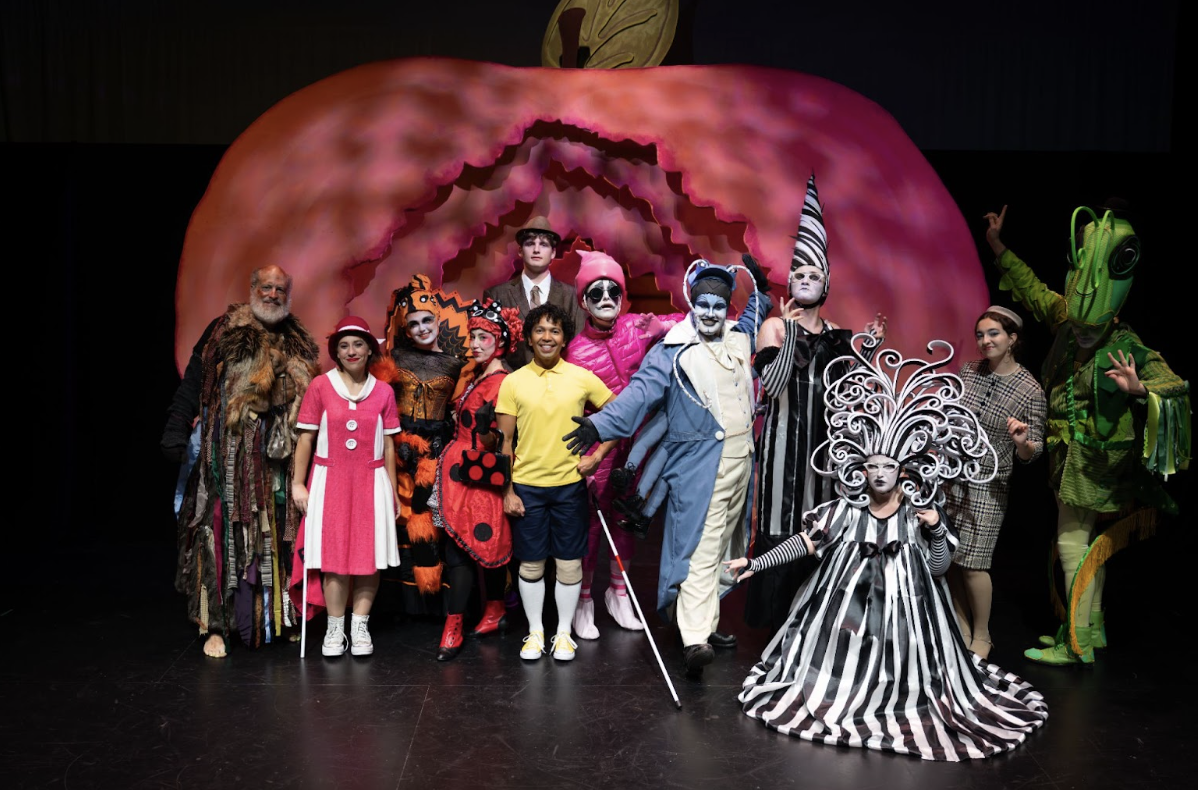
What began as a playful, imaginative production on the Cuesta College stage is now heading to a regional spotlight. Cuesta College’s Theatre Arts program will travel to perform “James and the Giant Peach” at the American College Theatre Festival.
“James and the Giant Peach” is a fun childhood story by Roald Dahl in which an orphan named James acquires magic that causes objects to grow to an abnormal size. After receiving magical crystals, a giant peach grows in his garden. James crawls inside, befriends human-sized insects, and embarks on a surreal, adventurous journey to New York City.
So many talented people came together to collaborate on a visually and emotionally distinct perspective on “James and the Giant Peach”. So when student co-director Cash Costango was asked about his feelings towards being acknowledged by ACTF he said, “Cuesta theatre is known for being very collaborative. And they really upheld that idea of, if we don’t know something, let’s figure it out together. And really incorporating the tech crew, the actors, I mean, everyone really came together.”
ACTF is an organization that recognizes and encourages quality college theater, showing over 18,000 students annually that they have the opportunity to improve their theater skills, have their work critiqued, and receive national recognition for excellence.
Cuesta’s theater program will be heading to Glendale this week to represent Cuesta in the western region. Colleges and universities from Arizona, Central and Southern California, Hawaii, Southern Nevada, Utah and Guam will also participate in the regionals section.
Following the recognition, student co-director Cash Costango said his initial reaction to advancing to regionals was shock. “I felt the work we did was worthy of it, and I knew we were up for that possibility, but I’d already kind of made my peace with the idea that it wasn’t going to happen,” he said. “So just shock and gratitude.”
Following that initial gratitude, Costango turned his focus to what the production was always meant to be: a source of joy. Though “James and the Giant Peach” was offered as an option by the artistic director of the Cuesta College Theatre Arts Program, bree valle, Costango said he was drawn to the chance to create a children’s theatre piece. “The biggest challenge was trying to make something fun and attention-grabbing, and at the same time keep its heart,” he said. “We wanted it to be just a little spot of joy in the world.”
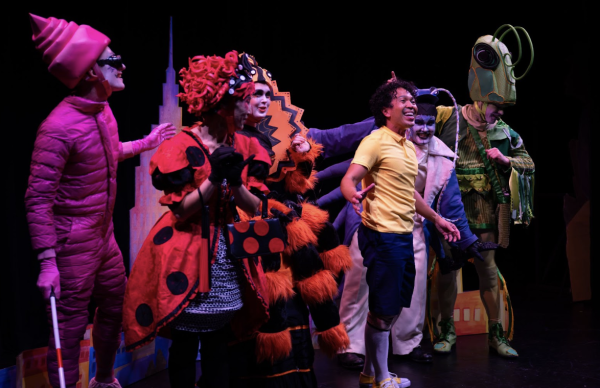
Costango described the rehearsal process as highly collaborative, shaped by his background in devised theatre. “Our ideas were the spear point,” he said. “Everyone could bring something to the table.” He added that the cast and faculty embraced student leadership with professionalism and trust.
Representing Cuesta College at the American College Theatre Festival holds special meaning for Costango, who has previously attended the festival as an actor. Returning with a show he helped direct feels full circle. Still, recognition was never the primary goal. When asked what he hopes audiences take away from the production, Costango answered simply: “Joy.”
In addition to a student-led creative team, the production was supported by staff who worked both onstage and behind the scenes. Ritchie Bermudez, associate director of marketing and communications at Cuesta College, returned to the stage as James while also helping promote the production. He described the experience as both personal and professional, saying that stepping back into the role of a student performer allowed him to fully engage in the collaborative and educational process.
While “James and the Giant Peach” is often associated with childhood, Bermudez said that the story carries emotional depth for audiences of all ages. “It’s visually playful, but it also has real heart.” Themes of resilience, imagination and belonging, he added, are what allowed the production to resonate beyond its whimsical surface.
Community response has been overwhelmingly enthusiastic, particularly from families and first-time theatre-goers. Seeing young audience members engage with the production, Bermudez said, reinforced the importance of early exposure to the arts. “My hope is that experiences like this spark a lifelong connection to live performance,” he said.
The ACTF selection further shaped how the production was shared with the public. For Bermudez, the recognition became an opportunity to highlight what Cuesta College offers its students. “This invitation reflects what’s possible when students are encouraged to take risks and believe in the power of the arts,” he said, calling the experience both humbling and affirming.
Ryan Flores, the lighting designer for the play, also explains the honor he feels from being selected. “It’s an amazing honor to have the show selected, especially considering that in the entire region, which is a large handful of states and colleges that have entered.” he continues to mention that, “Only four shows got picked, and we were one of them. So it’s really a great honor.”
Flores also discussed how important collaboration is for a show’s success. Unlike more rigid rehearsal processes, “James and the Giant Peach” allowed designers, directors and actors to experiment freely. “There’s no stupid idea. There’s no wrong choice to be made,” he said. “There’s only experiments to be had.” That openness, he added, allowed the team to explore multiple possibilities before landing on choices that best served the story.
To achieve selling the idea of emotion and fantasy to a general audience of children, Flores explains, you have to be willing to learn along the way. “I really feel this way in theatre that if you think that you’ve stopped learning, that’s the worst thing you can do. If you’re not always evolving and learning something, then you’re stagnant, and there’s nothing fun about being stagnant in my opinion.”
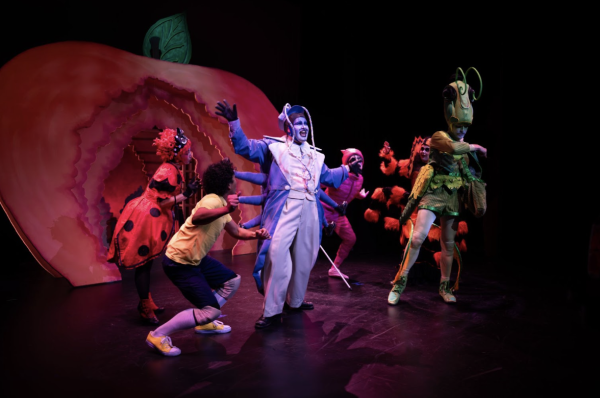
Flores reflects that one of his favorite lighting design moments comes at the very start of the show, just after the bugs are introduced. Each character stands in a spotlight, matching the color of their costume, before gathering around James. “We have this moment where all the bugs and James are there together in just this rainbow of color,” he said.
As James opens his book, the stage goes dark, except for the glow coming from the pages. “It shrinks down into the story starting now, where we’re intimately focused on James and the words that he’s saying.”
Moments like these reflect more than technical design; they reveal the collective care behind the production. The production brought together students, faculty, and community members.
“That level of belief from our audiences and community donors has made it possible for us to represent Cuesta College on a regional stage,” Bermudez said. “It’s something we don’t take for granted, and we hope we make them proud.”
As the outcome of the regional festival is uncertain, Cuesta College theatre program has the opportunity to advance to a national setting where the American College Theater Festival, takes student artists from colleges and universities across the country to share their work on a national stage.
Selected productions and individuals advance from eight regional conferences, where they are evaluated across all areas of theatre-making. From performance and direction to design and devised work. Those recognized are invited to participate in the national festival, where their achievements are celebrated alongside peers from across the nation, marking both a culmination of their work and what comes next.